
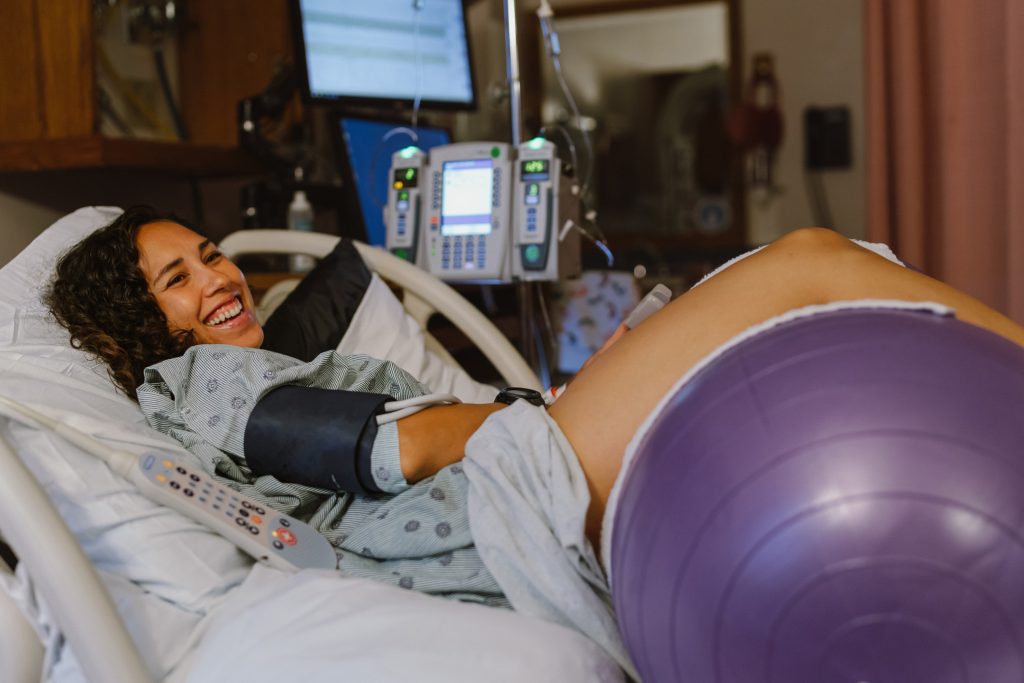







Are you concerned about how you’re going to push your watermelon-sized baby through an area the size of a lemon? Never fear! By learning how your body can birth your baby, you can address your fears. Read on to learn how your body accomplishes the pushing phase.
When it’s time to push your baby through the birth canal, your body will let you know that it’s ready through strong undeniable urges. This overwhelming sense of pressure and need to bear down (like straining during a bowel movement) will capture all of your thoughts and attention. You’ll feel these urges even if you’ve had an epidural.
Set Expectations with Your Pregnancy Care Provider and Birth Partner
Before you go into labor, discuss how much you want your pregnancy care provider involved with your birth process, and your preferences for pushing your baby out.
Identify who will support you in your third trimester and during labor. Talk to your partner, family, or friends about the support you want and include this information in your birth plan. For example, ask your partner if they’re willing to help you with a perineal massage, can your relative take photos and video, and is your friend able to help you change positions.
Share with your provider and birth partner if you’re going to have a doula supporting you physically and emotionally during labor and birth.
Popular Pushing Positions
There are a variety of positions you can assume while in labor and while pushing. Ask family and friends what positions helped them push their baby out. Call the hospital or birth center where you plan to birth to ask what labor support tools they provide.
Discuss with your labor nurses; you want positions that:
- Move your baby down into the birth canal
- Reduce the risk of tearing
- Protect your pelvic floor (muscles that protect your bladder, bowel, and uterus)
Choosing Pushing Positions
As you explore pushing positions, you’ll grow in gratitude as you marvel at how generations before you have given birth. Below are several positions that empower you as you bring your baby into the world.
Side-lying (Lying on your left or right side)
Pros:
- Comfortable position that helps you rest in between contractions
- Supports consistent blood pressure, this is particularly important if you have issues with high or low blood pressure
- Gravity neutral; helps baby better position themselves for birth
- Easy position with or without an epidural
Cons:
- Birth partner may need to hold your legs and feet
Hands and Knees (On all fours)
Pros:
- May relieve back pain and pressure
- Opens your pelvic outlet making birth easier for your little one and decreases risks of tearing
- Helps baby rotate into the position needed for birth
- Easy to rock back and forth, or side to side, to increase comfort and help baby get into position for birth
Cons:
- Puts pressure on your wrists and shoulders; lean on a birth ball or back of the bed to reduce this pressure
- Difficult to see what is happening
- Challenging to be in this position with an epidural
Tailor Sitting (Sitting upright with your knees apart and soles of your feet touching)
Pros:
- Opens the pelvis as gravity helps move baby down
- Lean forward and grab your knees or ankles during contractions while pushing to help baby move down
- Easy to relax into a pillow or back of the bed between contractions
- Can do this position with or without an epidural; may need help keeping your feet together with an epidural
Cons:
- May lead to perineal/pelvic swelling if done for long periods of time
Squatting (Feet shoulder width or farther apart and flat on the floor/bed, knees flexed, bottom below your knees)
Some birthing facilities have a squat bar to help with this position, ask your pregnancy care provider or birth facility ahead of time.
Pros:
- Opens the pelvis to encourage the baby to move down
- Gravity helps baby move down
- Makes contractions and pushing more effective
- May help birth baby faster
- May decrease perineal tearing
Cons:
- Increases pressure
- May need support to get in and out of this position
- Difficult to be in this position with an epidural
Birth Stool
Ask your birthing facility if this option is available.
Pros:
- Similar to squatting, opens the pelvis and encourages baby to move down
- May be easier to use than squatting without support
- Makes contractions and pushing more effective
- May help birth the baby faster
- May decrease perineal tearing
Cons:
- Not widely available
- Difficult to use with an epidural
Once you’re in labor use the positions that help you cope with contractions and push baby down and out. Try several positions while pushing. As baby moves down deeper into your pelvis, the position you’re most comfortable in may change.
Some moms change their position as often as every 10-15 minutes or more. Avoid pushing while lying flat on your back, as this slows the labor and increases the risk of perineal tearing. If you have an epidural and your birth partner helps hold your legs or feet, avoid pushing your knees directly into your chest.
Remember to relax your legs in between contractions. As you prepare to push baby out, take the opportunity to grab a quick sip of water or a few ice chips. You’re about to have your baby in your arms!